Are you thinking about setting-up antilag system but have no idea on where to start and which method to use? These basic steps in setting up antilag system on the e420c andSelect ECUs will give you a great idea on how and where to start. This will also tell you how to set-up basic drag style antilag to help with launching on laggy turbo cars.
First of all, let’s have a little bit of theory before we discuss about the basic steps for antilag-set-up. On a turbo car, the speed at which the turbo spools up is determined by 2 things. The size of the rotor on a small turbo is not that much but on a bit turbo it’s bigger than the amount of energy that we can impart onto the turbine. It’s actually enthalpy if you are a thermodynamicist but let’s just call it energy. So that is determined by the pressure of the exhaust gas coming out of the engine, how fast the gas is coming out which is determined by the engine
So we know that with most turbo systems, we can develop more boost at 3000 RPM at full throttle than we can at 2000 RPM at full throttle. And that is because exhaust gas is coming out faster. We also know that at say free driving or at say 15 percent throttle at 3000
2 Things the Way Antilag Work:
- First thing is that it increases the pressure of the exhaust gas. The way it will work is by forcing you to be at a higher throttle position. And to be at a higher throttle position, retarding the ignition timing is important. This means that the engine is actually producing less torque to maintain the rpm you need to put your foot down further.
- Second thing of what retarding the ignition do is that it increases the exhaust gas temperature. And which means that there is more heat available for the turbo. This will increase the enthalpy and energy and will make the turbo spin up faster.
So before you start following these basic antilag set-up guide, you need to be aware that you can or may burn out exhaust valves, turbochargers, make holes in manifolds, melt things and all that sort of thing. So if you do these steps, you do them at your own risk.
Steps in Basic Antilag Set-up
Step 1:
You need to set-up a couple of logic-only auxiliary outputs. So the first one you use is auxiliary output number 9 and you set that up as an
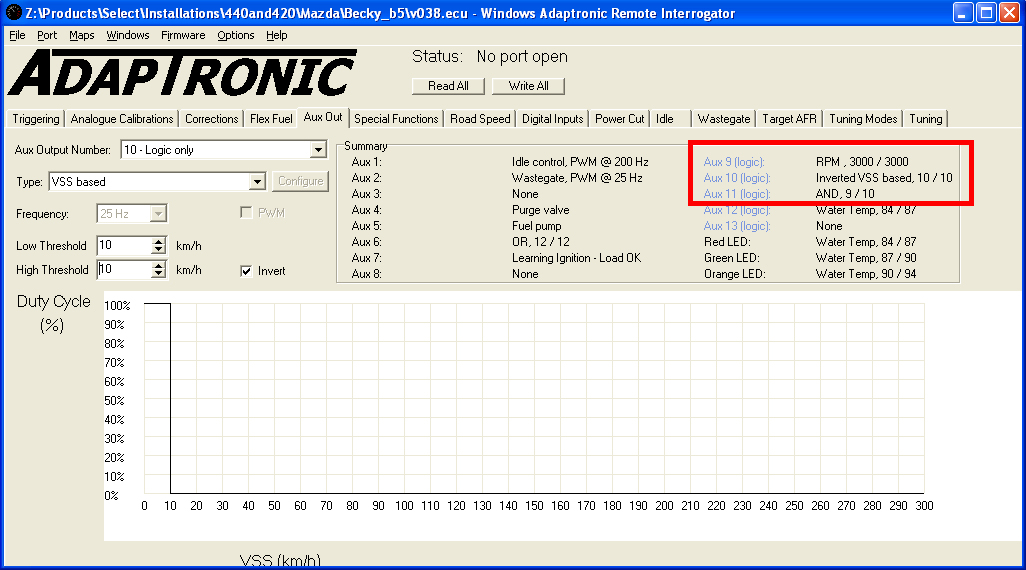
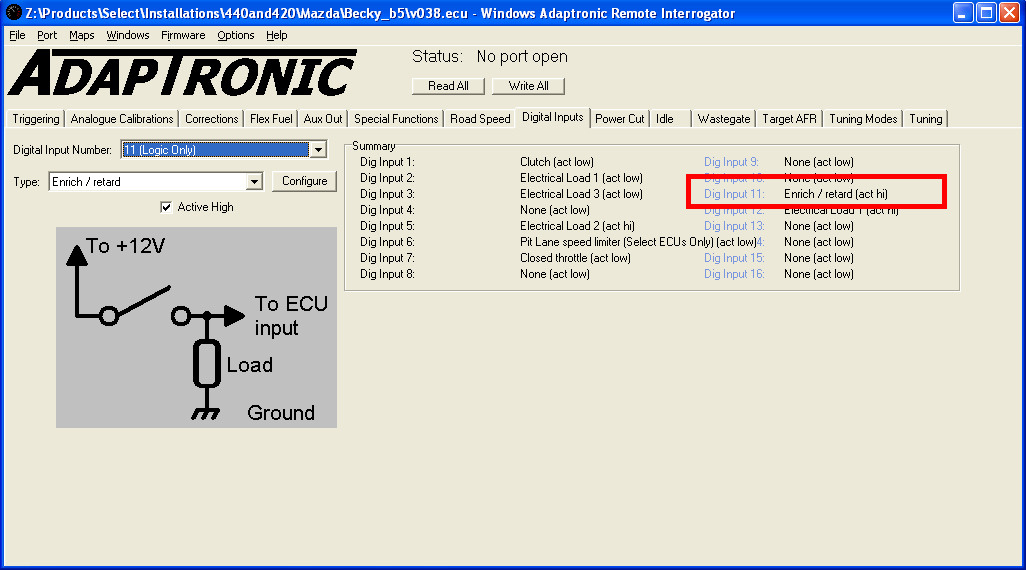
Now these outputs don’t actually go any pins on the ECU but they are still calculated internally. Auxiliary output 11 actually drives digital input 11 which again isn’t a real pin on the ECU and so what we do is we set digital input 11 as an Enrich Retard function. And note that you’ve got to set this as active high so that comes on when auxiliary output 11 comes on.
Step 2:
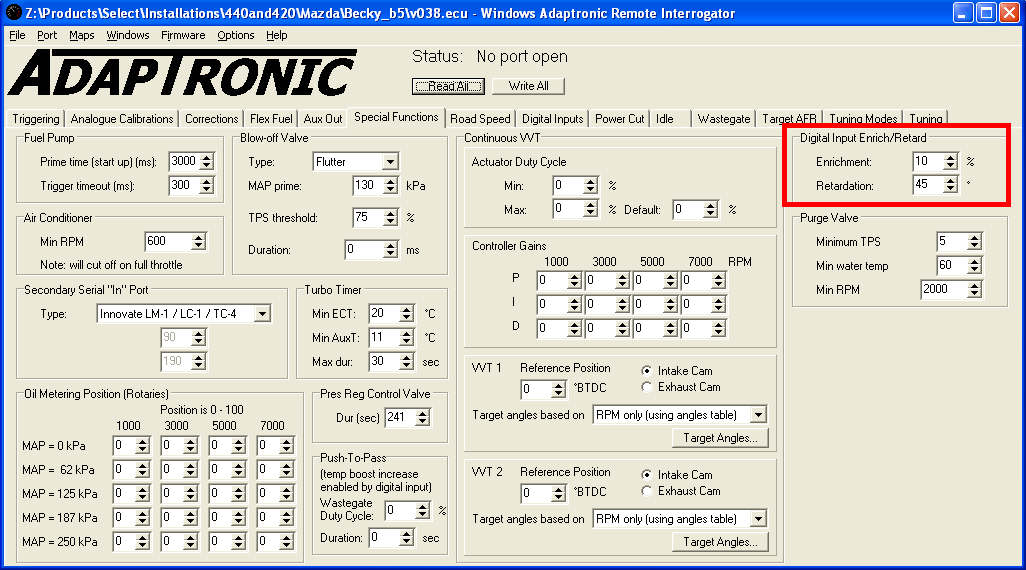
You will then have to set up the enrichment and retard function to enrich the mixture by 10% just to be safe and retard the ignition by about 45 degrees. You can also experiment with this on your own. This means that when we are above 3000
You can also set-up launch control function to kill the ignition above 3500

We hope that these basic steps for antilag set-up can help. Always make sure to be extra careful because things can get very hot if you do this.
For more information visit Forum